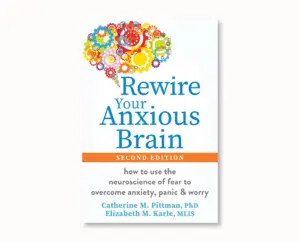
If you’ve ever caught yourself thinking, I know I’m fine, so why do I feel like this, you’ve already felt the disconnect this book is trying to explain. That gap between what you understand and what your body is doing is where anxiety becomes frustrating.
Rewire Your Anxious Brain by Catherine M. Pittman, PhD, and Elizabeth M. Karle takes a more practical, science-based approach to that experience. Instead of framing anxiety as something you should be able to control with better thinking, it looks at how fear responses are actually wired in the brain and why they don’t always respond to logic. The focus is less on quick fixes and more on understanding patterns, how they form, and how they shift over time.
These are the takeaways that stayed with us and genuinely changed how we approach anxiety day to day.
+ Not All Anxiety Is Coming From Your Thoughts
One of the most helpful shifts is realizing that anxiety doesn’t come from one place. The book breaks it down into two systems: the amygdala and the cortex.
The amygdala is responsible for fast, automatic reactions. It’s what drives the physical side of anxiety, the racing heart, the tension, the sense that something feels off. The cortex is where your thoughts live, including the overthinking, the replaying, and the constant “what if” scenarios.
Sometimes anxiety starts with your thoughts and builds from there. Other times, your body reacts first and your thoughts try to catch up after. Once you can tell the difference, it becomes easier to respond in a way that actually makes sense for what’s happening.
+ You Can Know You’re Safe and Still Feel Anxious
This is the part that tends to throw people off the most. You can understand a situation logically, walk yourself through it, and still feel anxious anyway.
The reason comes back to how the amygdala works. It doesn’t rely on logic or reasoning. It relies on patterns and past associations. If something has been linked to stress or discomfort before, your brain can flag it again automatically, even when there’s no real threat in the moment.
That’s why anxiety can feel out of proportion. It’s not always reacting to what’s happening right now, it’s reacting to what your brain has learned to expect. Once you see it that way, it feels less like you’re doing something wrong and more like you’re dealing with a pattern that hasn’t updated yet.
+ Overthinking Keeps the Cycle Going
When anxiety is more thought-driven, it usually doesn’t stay contained. It turns into a loop.
You replay a situation, try to figure it out, look at it from a different angle, then circle back again. It can feel like you’re being productive, like you’re trying to solve something, but most of the time it just keeps the anxiety active.
The cortex is built to analyze and problem-solve, but it doesn’t always recognize when there isn’t a clear answer to find. In those moments, continuing to think it through doesn’t bring resolution, it just extends the cycle.
Learning to step out of that loop, even briefly, can interrupt the momentum in a way that overanalyzing never does.
+ Anxiety Is Something You Retrain, Not Fix Instantly
A lot of people approach anxiety like something that should be shut down quickly if you just find the right approach. This book reframes that idea completely.
Anxiety is something the brain learns over time, which means it also changes over time. For anxiety that’s more physical, the process usually involves gradual exposure. Letting your brain experience the situation without the outcome it expects, and repeating that enough times that the association starts to shift.
For anxiety that’s more thought-based, the work is in how you engage with those thoughts. Not every concern needs to be followed all the way through, especially when it’s not leading anywhere useful.
It’s not about fixing everything in one moment. It’s about changing how you respond, consistently enough that the pattern starts to shift.
+ One Strategy Doesn’t Work for Every Kind of Anxiety
It’s easy to look for a single solution, something you can rely on no matter what. The book makes it clear that this approach usually falls short.
If your body is reacting, trying to reason your way out of it might not do much. If your mind is spiraling, sitting in those thoughts can make them stronger. The response has to match what’s actually happening.
That shift sounds simple, but it changes how you handle anxiety in real time. Instead of defaulting to the same approach every time, you start paying attention to whether you’re dealing with a physical response or a mental loop and adjusting from there.
The post 5 Things We Learned From Rewire Your Anxious Brain That Actually Changed How We Handle Anxiety appeared first on The Chalkboard Mag.